The Tale of the Human Chain and the Pulley Operator: Navigating the New Physics of Engineering
Apr 2, 2026
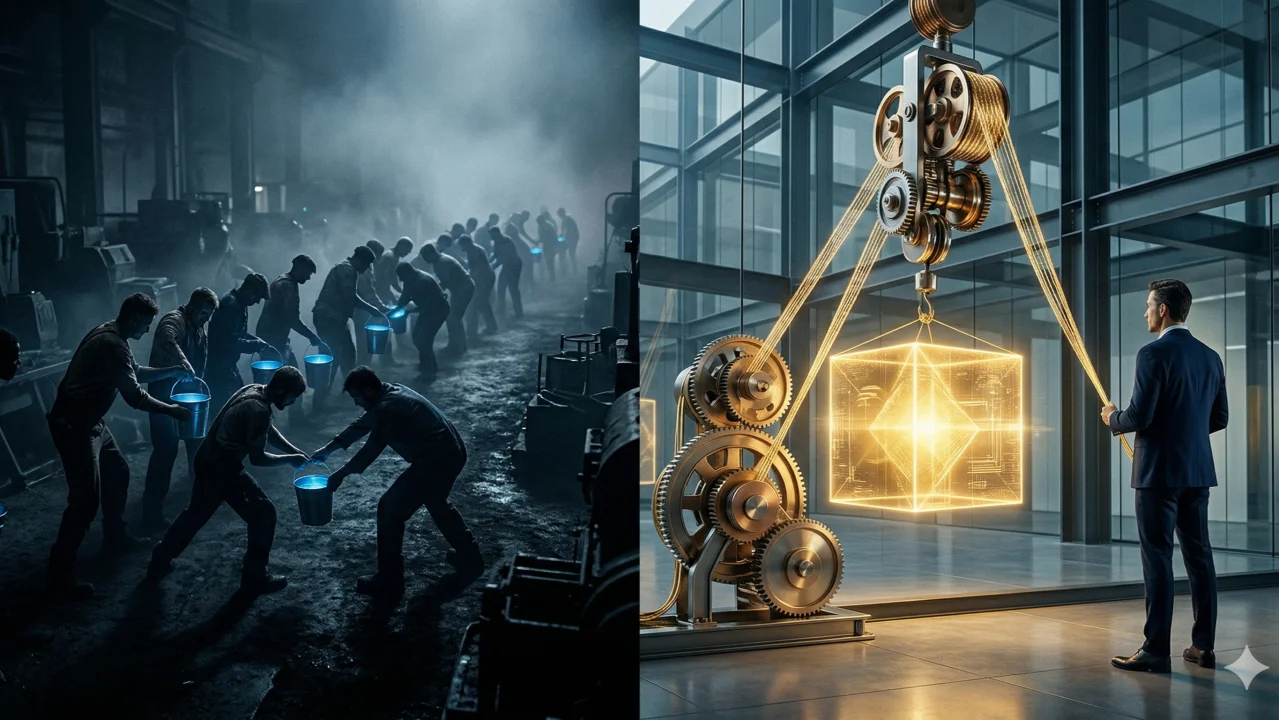
In the old world of engineering leadership, we were taught that safety lived in numbers. If a project was falling behind, we added "people." If a system was complex, we built a larger team to distribute the cognitive load. We were building a Human Chain.
We are moving from scaling output through people to scaling impact through leverage. This fundamentally changes how we hire, measure, and lead.
But the physics of software development has changed... We are no longer managing chains; we are managing Pulley Operators.
If you try to manage a pulley system with the mindset of a human chain, the system won't just fail. It will snap, often silently in production where errors scale faster than humans can detect them.
The Era of the Human Chain (The "Legacy" Mindset)
Imagine a village fire. To stop it, fifty people line up from the well to the blaze, passing buckets of water from hand to hand.
- The Logic: Resilience through redundancy. If one person tires, someone steps in. The speed of the line is determined by the slowest person.
- The Leadership Role: You are a Coordinator of Flow. You monitor attendance, count buckets, and ensure the line isn't breaking. You hire for "coverage" (filling seats in the chain).
The Hidden Cost: Coordination overhead. Fifty people require immense management. You spend more time talking about passing buckets than actually putting out the fire.
The Rise of the Pulley Operator (The "Leveraged" Mindset)
Now, imagine a single person standing at the edge of that same well. They aren't holding a bucket; they are holding a high-tensile rope attached to a massive, multi-gear Pulley System.
With one pull, they can lift ten times the water of the entire human chain. This is the AI-leveraged engineer. The "pulley" is the AI—it generates the code, automates the boilerplate, and handles the heavy lifting of syntax.
- The Logic: Resilience through precision. One person can now do the work of ten, but the real value lies in understanding the system deeply, not just operating it.
- The Leadership Role: You are no longer a coordinator; you are a Technical Architect of Tension. You aren't checking if "buckets are moving"; you are checking the integrity of the rope and the placement of the gears.

In the age of AI leverage, the leader's value shifts from coordinating volume to calibrating the precision of the system.
The Transition: Managing the Mindset Shift
Moving from the Chain to the Pulley requires a fundamental shift in how we lead. Here is how to navigate that transition:
1. From Capacity to Capability
In a Human Chain, "average" is fine because the group compensates for the individual. In a Pulley system, an "average" operator is a liability. If they don't understand the physics of the system, they will break the machinery.
- The Shift: You must move from hiring for coverage (filling seats) to hiring for density (extreme skill). A team of three Pulley Operators will outbuild a chain of thirty bucket-passers.
2. From Writing to Curation
When the "Pulley" (AI) can generate 1,000 lines of code in seconds, the bottleneck is no longer production—it is validation.
The best engineers are no longer those who write the most code. They are the ones who reject the most bad code.
- The Shift: We must stop rewarding "code written by hand." In fact, code written by hand is now a luxury we often can't afford. The new metric is Curation Integrity. Does the engineer know why the AI chose that specific pattern? Can they spot the subtle "fray" in the logic before it snaps under production load?
3. Deep Product Thinking as the "Anchor"
The danger of a Pulley is that it makes it very easy to lift the wrong thing very quickly.
- The Shift: Because the "coding" part is becoming faster and cheaper, a disproportionate amount of time must now shift toward Product Thinking and understanding the "Why", as the "How" is increasingly handled by the gears.
The Leadership Challenge: Embracing the Silence
The hardest part of this shift for many leaders is the silence.
A Human Chain reassures you with activity. A Pulley System demands trust without noise.
A Human Chain is loud. There are meetings, status updates, and a constant hum of "passing buckets." A Pulley Operator works in relative quiet. The work is concentrated, cerebral, and highly leveraged.
As a leader, your job is no longer to keep the line moving. Your job is to ensure that your operators have the highest-quality "ropes" (tools), the most efficient "gears" (architectures), and the mental clarity to know exactly where to apply the tension.
Are you still optimizing for scale, or have you started designing for leverage?
#EngineeringLeadership #AIinEngineering #TechLeadership #SoftwareEngineering #DigitalTransformation