Blue/Green vs. Canary Deploys: The Tale of Two Bridges
Dec 27, 2025
Blue/Green vs. Canary Deploys: The Tale of Two Bridges
December 27, 2025
Are you opening a brand-new bridge to everyone at once, or are you letting a few cars cross while inspectors watch for vibrations?
In software delivery, how you expose a new version (v2) to your users determines your risk profile, your incident blast radius, and your rollback speed.
To visualize this architectural choice, let’s visit a river city on launch day.
The Tale of Two City Planners: Bella vs. Cyrus
Bella and Cyrus are both tasked with upgrading the city’s main bridge. However, they manage risk in very different ways.
Bella’s Blue/Green Strategy (The Double Builder)
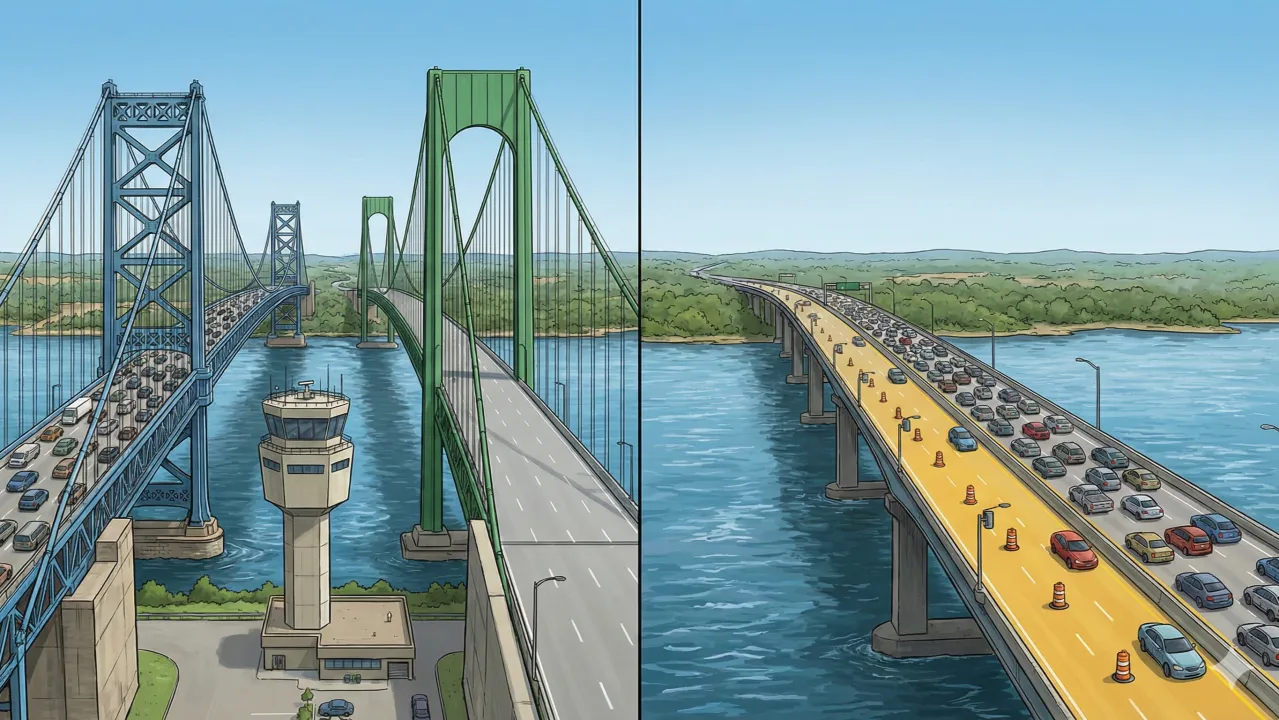
Bella doesn't trust repairs on a live bridge. Instead, she builds a completely new Green Bridge right next to the old Blue Bridge.
The Process:
She builds Green in secret. She runs heavy trucks over it to test it (Smoke Tests). When she is 100% sure it’s safe, she flips the main traffic switch. All cars instantly divert from Blue to Green.
The Pro (Instant Safety):
If a crack appears on the Green bridge 5 minutes later, she flips the switch back. Everyone is safe on Blue instantly.
The Con (The Cost):
The city had to pay for two full bridges just to use one.
Cyrus’s Canary Strategy (The Lane Opener)
Cyrus thinks building a second bridge is a waste of money. Instead, he upgrades the bridge one lane at a time.
The Process:
He opens Lane 1 (the Canary lane) to the new surface. He directs 5% of the traffic into that lane and watches the sensors closely. If the sensors are stable, he opens Lane 2, then Lane 3.
The Pro (Blast Radius):
If Lane 1 collapses, only 5% of the cars are affected. The other 95% on the old lanes are fine.
The Con (The Complexity):
Managing the traffic flow is a nightmare. Cyrus needs advanced signaling (Routing Rules) to ensure the right cars go into the right lanes.
The Technical Bridge: Architectural Implications
When we translate this to System Design, we are balancing Cost (Infrastructure) against Precision (Traffic Shaping).
1. Blue/Green Deployment (The Router Flip)
Architecture:
You maintain two identical production environments (Blue = Live, Green = Idle).
The Mechanism:
The Load Balancer points 100% of traffic to Blue. You deploy v2 to Green. Once validated, you update the Load Balancer to point 100% to Green.
The Mental Model:
A light switch. It is either ON (v2) or OFF (v1).
When to use it:
- Database Schema Changes: When the change is complex and you need a clean cutover.
- Critical Systems: When you need a guarantee that you can revert to a known good state in <1 second (e.g., Payment Gateways).
2. Canary Deployment (The Weighted Flow)
Architecture:
You have one production environment, but you replace instances incrementally (e.g., Kubernetes Rolling Update with traffic splitting).
The Mechanism:
The Load Balancer uses weighted routing. It sends 95% of requests to v1 nodes and 5% to v2 nodes.
The Mental Model:
A dimmer switch. You slowly brighten the room.
When to use it:
- User-Facing Features: You want to see if the new "Checkout Button" actually converts better before showing it to everyone.
- High-Scale APIs: You can't afford to double your infrastructure cost (Blue/Green) for a cluster with 1,000 nodes.
The Decision Guide (Cheat Sheet)
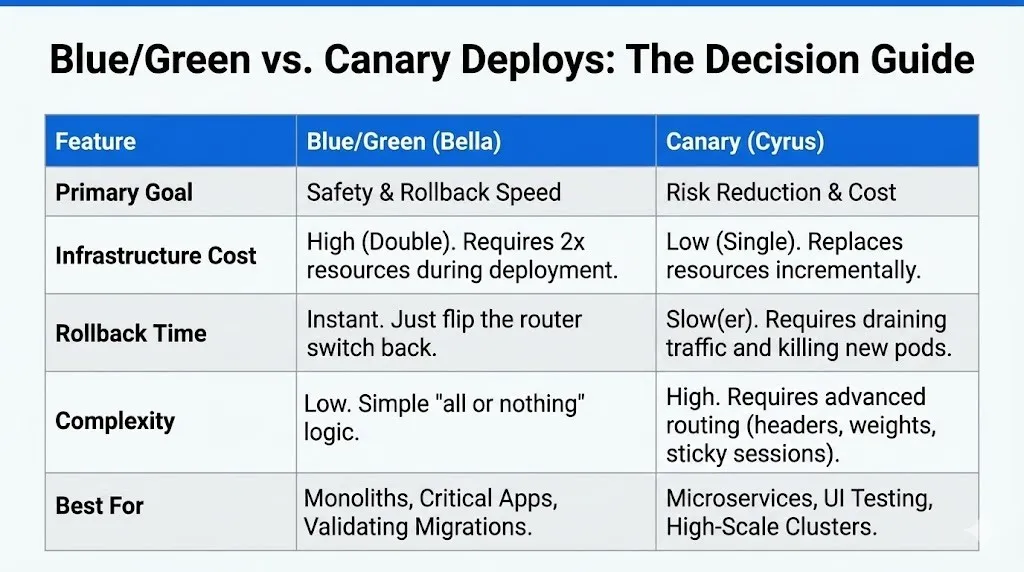
Generated using Gemini
Infographic for Visual Learners
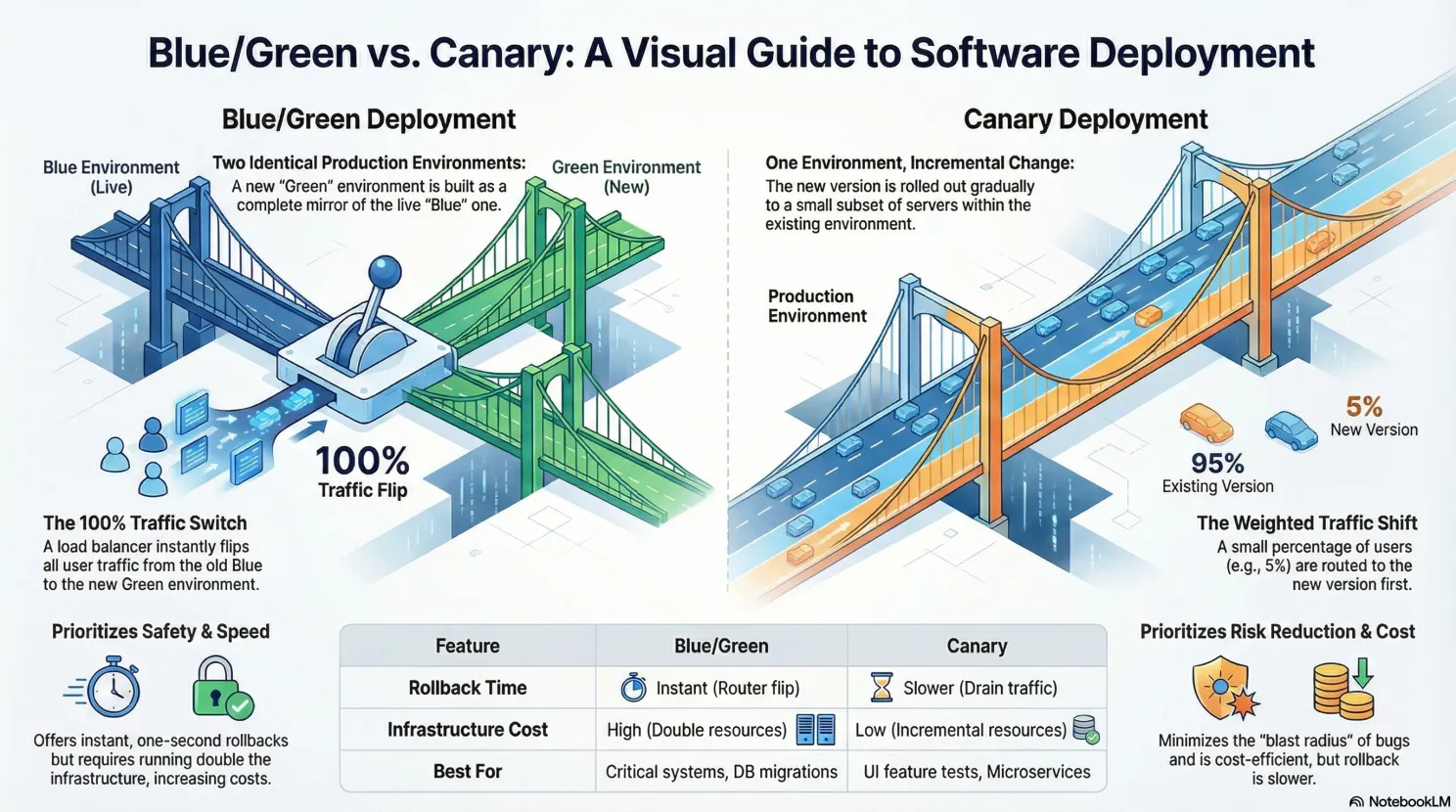
Right-click and Open Image in New Tab for expanded view. Generated using NotebookLM
The "Watch-Outs" for Leaders
Even the best bridge can collapse if you ignore the foundations. Here are the common pitfalls I see in Enterprise Architecture:
1. The Database Trap (Blue/Green)
The Risk:
Since Blue and Green usually share the same database, a schema change for Green can break the live Blue app.
The Fix:
You must use the Expand/Contract pattern. Ensure all DB changes are N-1 compatible (e.g., add a new column rather than renaming an old one) so both versions can read the DB simultaneously.
2. The "Noisy Canary"
The Risk:
Sending 1% traffic might not generate enough errors to trigger your alarm. You might think it's safe, expand to 100%, and then crash.
The Fix:
Ensure your sample size is statistically significant before promoting.
3. Session Bleed
The Risk:
A user hits the Canary (v2), logs in, and then the next request hits the old version (v1) which doesn't recognize their session.
The Fix:
Use Sticky Sessions (Session Affinity) at the Load Balancer level.
Conclusion
Use Blue/Green (Bella) when you need a clean, reversible cutover and can afford the infrastructure.
Use Canary (Cyrus) when you want evidence from real traffic with tight blast-radius control.
The best teams mix both by using Blue/Green for major architectural upgrades and Canary for daily feature releases.
#DevOps #SRE #SystemDesign #SoftwareArchitecture #EngineeringLeadership